Methylene Blue: 150 Years of History


Methylene Blue Is 150 Years Old. So Why Is Everyone Just Hearing About It?
It started as a dye for cloth, became the first synthetic medicine, and went to war long before it reached a supplement shelf. Here is the whole story in seven moments, including the one most brands would rather you skip.
GMPCertified facilityNSF and GMP certified

It started life as a dye for cloth.
In 1876, a chemist named Heinrich Caro created a new blue dye for wool at BASF in Germany. A year later it became the company's first patent for a coal tar dye.1
That is where the story begins, and it is also why the grade on the label still matters. The same molecule is made today for dyeing, laboratories and aquariums, and none of those grades is meant to be swallowed.
What "USP Grade" actually protects you from
Industrial, laboratory and aquarium methylene blue are made for those jobs, not for something you take by mouth. USP Grade means the material meets United States Pharmacopeia standards.9
It is the single most important word on a methylene blue label, and it is the first thing we check when we test another brand.

It showed scientists what was inside a cell.
Methylene blue clings to some parts of a cell and ignores others, so under a microscope it made invisible things visible. By 1886, Paul Ehrlich was using it to stain the parasite that causes malaria.1
Watching a dye find one target and leave the rest alone gave Ehrlich an idea that shaped modern medicine.
The idea it gave him
If a dye could seek out one kind of cell, Ehrlich reasoned, a compound could be built to seek out a disease. He spent the rest of his career chasing what he later called a "magic bullet."
Five years after that first stain, methylene blue became his first attempt at one.

It became the first synthetic drug ever given to a patient.
In 1891, Ehrlich and Paul Guttmann treated two patients with malaria in Berlin using methylene blue. It is generally credited as the first fully synthetic compound ever used in clinical medicine.2
Before that moment, medicines came from plants, minerals and animals. After it, chemists knew they could build one.
Why it didn't stay a malaria drug
Quinine was already available, and it eventually took over. But methylene blue kept shaping medicine anyway.
Chemists studying its structure found a compound called phenothiazine, which became the starting point for some of the first antipsychotic medications and the tricyclic antidepressants.8 That family connection is exactly why methylene blue must never be taken alongside antidepressants.7

It went to war in the South Pacific.
During World War II, Allied troops in the South Pacific took methylene blue to prevent and treat malaria.8 It came with a side effect every soldier noticed.
It turned their urine green and the whites of their eyes blue. The side effects were harmless, but soldiers noticed, and disliked them enough that methylene blue eventually fell out of favor as an antimalarial.8
The blue urine still happens today
It is harmless and temporary, and it is simply the compound passing through. We tell every customer to expect it, so nobody gets a surprise on day one.

It went from the battlefield to the operating room.
In 1933, physicians documented methylene blue reversing methemoglobinemia, a blood condition where red blood cells cannot carry oxygen properly.5 Within a few years it was the standard treatment, and it still is. Surgeons started using it as a dye too, tracing lymph nodes and locating the parathyroid glands during operations, because it stains some tissue and not others, the same property Ehrlich noticed back in 1886.
Is that still how hospitals use it today?
Yes. In 2016, the FDA formally approved a branded injectable version, ProvayBlue, for the methemoglobinemia use, the first approved therapy for that specific condition.5 The underlying use in hospitals goes back decades earlier than that approval.

Researchers discovered less can do more.
Scientists studying methylene blue found something unusual. At very low doses it helps mitochondria, the part of every cell that makes energy, pass electrons along more efficiently. At high doses it can do the opposite.11
That is why people talk about microdosing methylene blue. The research interest is in small amounts, studied for cellular energy and memory, not the large doses used in hospitals.3*
Why more isn't better
Researchers call this a hormetic response. Methylene blue cycles electrons back and forth at low doses, which is the effect being studied. Push the dose too high and that cycle breaks down, and the benefit reverses.11
It is also why doubling up on a supplement is not the same as doubling the effect. We're not allowed to give dosing advice, so what is right for you is a conversation for your doctor.
“I noticed an immediate difference in my energy levels, focus, temperament, and overall stress levels. It's really everything it's marketed to be.”Verified buyer · Blue Boost 60
“I take it in the morning and I'm locked in all day. Didn't expect it to work this fast.”Verified buyer · Blue Boost 60

We put it in a capsule you could actually order.
Nutricel began in 2020, when a father and son were caring for family members and ran into the same problem you might have: no methylene blue product they actually trusted. In December 2022, they listed what we believe was the first methylene blue capsule on Amazon.
Orders went from one a day to ten, then twenty. It stayed a family operation the whole way.

Then it came up on a podcast with millions of listeners.
When methylene blue came up in a conversation on The Joe Rogan Experience, ours was still the only capsule listing we could find on Amazon. Demand spiked overnight.
Around the same time, HHS Secretary Robert F. Kennedy Jr. was seen in a video adding a blue liquid, widely presumed to be methylene blue, to a glass of water. He never said what it was on camera, and neither he nor HHS has endorsed any brand, but it put the compound in front of a national audience.
How we kept up with demand
At one point we were running four manufacturing facilities at once just to stay in stock, all while holding our price as look-alike products started flooding in behind us.

Now it's everywhere, and most of it isn't the real thing.
Early in 2026, methylene blue went from a medical footnote to the front page of the internet. Dozens of new brands appeared almost overnight.
We bought 61 of them and tested them. 39 failed a lab test or a water test.4 A compound that took 150 years to earn its reputation can be undone by a bottle with almost nothing in it.
Where Blue Boost fits into this story
We made the original methylene blue capsule, and when the rush began in February 2026, ours was still the only one on Amazon.
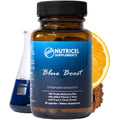
Blue Boost is USP Grade methylene blue at 12mg, independently tested by Eurofins, and made in the USA. It is the version of this 150-year-old compound we would give our own family.
With most methylene blue capsules, you might not be getting what you think you're getting. Nobody in the space was paying for independent testing, so we bought 61 competing products, paid for the testing ourselves, and published every result.

150 years later, we're the number one selling capsule in America.
From a hand-labeled batch to the number one selling methylene blue capsule in America. Same standards, same family, same compound Ehrlich started with in 1891.
We're still USP Grade, still independently tested, still made in the USA, and still the one we'd give our own family.

Blue Boost
Methylene Blue Capsules
- USP Grade Methylene Blue (12mg)
- Vitamin C Ester
- Organic Cacao Powder
Free shipping. Ships same day, Monday to Friday. Money-back guarantee. Made in the USA.
 100% money-back guarantee. If it isn't right for you, get in touch and we'll work with you.
What should you expect?
The label direction is one capsule daily. Here is what customers typically report, including the part most brands leave out.
Take one, and test one
Most customers report taking it earlier in the day rather than late, since a few find it harder to wind down at night. Open a second capsule into a glass of water if you want to watch it turn midnight blue for yourself.
Most people notice something
Steadier energy, and thinking that holds into the afternoon. 76% of surveyed customers were here by day three6.*
Blue-green urine, and that is normal
It's the compound passing through and it clears within hours. Nothing has gone wrong. We would rather you expect it than be surprised by it.
Sixty capsules, sixty days
At the label direction, a bottle lasts two months. If it isn't doing anything for you, get in touch and we'll work with you.
*Self-reported customer survey, not a controlled clinical trial. Individual results vary.
Anything We Didn’t Cover.
Consult your doctor before use. Do not use with SSRIs or antidepressants. Do not take when pregnant or breastfeeding. Not for use under the age of 18. If any adverse reactions occur, stop using this product and consult your doctor.
Can I take this with antidepressants?
No. Methylene blue has monoamine oxidase inhibiting activity, and combining it with SSRIs, SNRIs, MAOIs, or other serotonergic drugs carries a risk of serotonin syndrome, which is serious. This is the single most important contraindication and we'll not soften it. If you take any antidepressant, don't use this product without your doctor’s explicit direction.
Is it safe if I have G6PD deficiency?
No. People with glucose-6-phosphate dehydrogenase (G6PD) deficiency should avoid methylene blue, as it can trigger hemolysis. If you don’t know your G6PD status and have a family history, ask your doctor for a test before using.
Can I take it while pregnant or nursing?
No. Methylene blue isn't recommended during pregnancy or while breastfeeding. Please speak to your OB or healthcare provider.
Can I give this to my kids?
No. Blue Boost is formulated for adults only. Keep it out of reach of children.
Can I take it with my other supplements?
We're not allowed to clear your specific stack, and combinations are exactly the kind of question your doctor or pharmacist should answer. What we can flag is the documented one: methylene blue has monoamine oxidase inhibiting activity, so anything serotonergic, including St. John's Wort, 5-HTP, SAM-e, and tryptophan, carries the same serotonin syndrome risk as antidepressants7. Take that list, and everything else you take, to your provider.
Is it safe long term?
Methylene blue has over 130 years of documented pharmaceutical use, but long-term daily supplement use in healthy adults hasn't been studied as thoroughly as its acute clinical use. That's an honest gap in the evidence, not a reassurance. Ongoing daily use is a decision to make with your healthcare provider.
Is it legal?
Yes. Methylene blue is legal to purchase and use in the United States as a dietary supplement ingredient. Blue Boost is manufactured domestically in FDA-registered, NSF and GMP certified facilities.
Are there side effects?
The most common is temporary blue-green discoloration of urine. Less commonly, some people report mild nausea, headache, or dizziness, most often at higher doses than ours. If anything feels off, stop and talk to your doctor.
Can I drive or operate machinery on it?
Methylene blue is not a stimulant and not a sedative, and customers don't report impairment. We're not allowed to tell you it's safe for you to drive, so ask your doctor first if you have any concern about alertness.
Will it turn my mouth blue?
No. You swallow the capsule whole and it doesn't dissolve until well past your mouth, so nothing blue ever touches it. This is one of the practical reasons we started with a capsule. Liquids and powders held under the tongue do tint, which is a trade-off of that delivery route.
Will it turn my urine blue?
Yes, expect a blue or blue-green tint. This is normal, well-documented, and simply the compound passing through. Isn't a sign of a problem.
Will it stain my teeth?
No. The capsule goes down intact, so the methylene blue inside never reaches your teeth. Where staining does happen with other forms it's surface-level and temporary, but with a capsule it isn't a concern in the first place.
What if I get it on clothes or countertops?
Methylene blue stains fabric and porous surfaces readily, so it’s worth handling any form with a little care. A sealed capsule is the most spill-proof option, which is why we started there.
We're not allowed to give medical or dosing advice. The label direction is one capsule daily. Anything below is either what the label says or what customers typically report doing, and none of it replaces your own doctor.
Capsule, liquid or gummy: does the form change how well it works?
Each route has trade-offs. Sublingual forms absorb through the mouth and act faster, but tint more and are harder to dose precisely. Capsules go through digestion, which is slightly slower, but give you an exact, repeatable dose with no measuring and no mess. Neither is universally better. It depends on whether you value speed or precision. Blue Boost is a capsule because a fixed daily dose is what most people actually want from a supplement they take every morning.
When should I take it?
The label direction is one capsule daily. Most customers report taking it in the morning or early afternoon. We're not allowed to advise you on timing, so that one is for you and your doctor.
With or without food?
The label doesn't require either. Some customers report that a meal helps with mild stomach sensitivity. We're not allowed to advise you beyond that, so ask your doctor if you're unsure.
Should I cycle it?
Some long-term customers report doing so, commonly five days on and two days off. We're telling you what we've heard, not recommending a schedule, because we're not allowed to. Whether to cycle is for your healthcare provider to answer.
What if I miss a day?
The label direction is one capsule daily, and it doesn't cover making up a missed one. We're not allowed to advise you either way on that, so ask your doctor if you're unsure.
Can I take it with coffee?
Yes. Methylene blue is not a stimulant, so it doesn’t stack with caffeine the way a second coffee would. Plenty of customers take it alongside their morning cup.
Will it keep me up at night?
Methylene blue is not a stimulant. Most customers report no effect on their sleep, and those who are sensitive report taking it earlier in the day. We're not allowed to advise you on timing, so raise it with your doctor if sleep is a concern.
Is it addictive?
No. Methylene blue isn't habit-forming and has no known dependency profile.
Will I build a tolerance?
Some long-term customers report effects feeling less pronounced over time, which is why cycling comes up. Blue Boost is 12mg per capsule. We're not allowed to advise you on what to do about that, so it's a question for your doctor.
What does “USP Grade” actually mean?
USP Grade material meets United States Pharmacopeia purity standards, the benchmark used for pharmaceutical-quality ingredients. It’s the meaningful line between material intended for human use and material intended for other purposes.
Is this the same as aquarium methylene blue?
Same molecule, different manufacturing standard. Aquarium and laboratory grades are produced for those purposes, not for human consumption. Blue Boost uses USP Grade material, independently tested by a third-party lab.
What exactly gets tested?
Third-party lab testing covers two things. Purity confirms there are no heavy metals and no microbial contamination. Potency confirms the amount of methylene blue in the capsule matches the 12mg on the label. Potency is the one most brands skip, and it’s where most failures happen.
Where is it made?
Manufactured in the United States in FDA-registered, NSF and GMP certified facilities. Formulated, encapsulated, bottled, and packaged domestically.
Why is this more expensive than what I see elsewhere?
Grade and testing. USP Grade pharmaceutical raw material costs substantially more than industrial grade, and independent third-party testing is an ongoing cost most sellers skip entirely. That difference is the price.
Is it vegan / gluten free?
The formula contains no gluten and no animal-derived ingredients or gelatin.
How fast does it ship?
Orders placed Monday through Friday are processed the same day, with free shipping on every order.
What if it doesn’t work for me?
Get in touch and we'll work with you. Most of the time that means your money back. We’d rather refund you than have you keep something you don’t believe in.
Can I cancel a subscription?
Any time, with no phone call and no retention maze. You can skip a delivery, change the frequency, or cancel from your account in a couple of clicks.
How should I store it?
Cool, dry place, out of direct sunlight, with the cap sealed. No refrigeration needed.
Sources
- Heinrich Caro's 1876 discovery of methylene blue as a wool dye, BASF's 1877 coal tar dye patent, and Paul Ehrlich's use of it to stain the malaria parasite by 1886. BASF, "Pioneering thinker, then and now: Methylene blue."
- Guttmann P., Ehrlich P. (1891), first clinical use of methylene blue against malaria, generally credited as the first fully synthetic compound used in clinical medicine. Reviewed in "Efficacy and safety of methylene blue in the treatment of malaria: a systematic review," BMC Medicine (NCBI PMC).
- Gonzalez-Lima F., Bruchey A.K., Rojas J.C., research on low-dose methylene blue, mitochondrial cytochrome oxidase activity and memory retention. "Neurometabolic mechanisms for memory enhancement and neuroprotection of methylene blue," Progress in Neurobiology.
- Nutricel Methylene Blue Brands Testing Database. 165 products tracked and 61 independently tested by water test, lab test, or both, last updated 14 July 2026. Testing conducted and funded by Nutricel; results reflect the specific units and lots obtained. View the full dataset.
- U.S. Food and Drug Administration approval of ProvayBlue (methylene blue) injection for acquired methemoglobinemia, 2016. ProvayBlue prescribing information (accessdata.fda.gov). A prescription drug; not related to any dietary supplement.
- Self-reported survey of Nutricel’s first 1,000 customers. Self-reported customer data, not a controlled clinical trial. Individual results vary.
- Contraindications per published safety guidance on methylene blue, including serotonin syndrome risk with serotonergic drugs and hemolysis risk in G6PD deficiency. See StatPearls, "Methylene Blue" (NCBI Bookshelf) and consult your healthcare provider.
- Schirmer R.H., Adler H., Pickhardt M., Mandelkow E. (2011). Review covering methylene blue's use by Allied troops in World War II and its role as the lead compound for phenothiazine drugs. "Lest we forget you, methylene blue," Neurobiology of Aging.
- USP Grade denotes material meeting United States Pharmacopeia standards.
- Historical images from Wikimedia Commons: BASF works, Ludwigshafen, 1881 (public domain); Paul Ehrlich, 1915 (public domain); "Prevent malaria. Shorten the war," U.S. National Archives (public domain).
- Bruchey A.K., Gonzalez-Lima F. (2008). Documents a hormetic dose response to methylene blue, with opposite effects at low and high doses. "Behavioral, physiological and biochemical hormetic responses to the autoxidizable dye methylene blue," American Journal of Pharmacology and Toxicology (NCBI PMC).
*These statements have not been evaluated by the Food and Drug Administration. This product is not intended to diagnose, treat, cure, or prevent any disease. Consult your doctor before use, particularly if you take SSRIs or other antidepressants, are pregnant or breastfeeding, or have G6PD deficiency.